
TPP at a Glance
What a Tenant Protection Plan Really Does
A Tenant Protection Plan is part of the construction documents for work in an occupied residential or mixed-use building. It tells the Department of Buildings, the contractor and the residents exactly how people living in the building will stay safe, keep their exits, and keep their essential services while construction is underway.
The law requires the plan to be site specific. A page of generic notes saying “contractor shall comply with all codes” is not enough. The plan has to show the real conditions of the building and the actual means and methods that will be used, and it can be submitted in phases as the work moves through the building.
When Is a TPP Required?
The trigger is simple: will any dwelling unit be occupied while the work is performed? If yes, a TPP is required before DOB issues the permit. In practice, that includes situations owners often overlook:
- Co-ops and condominiums. It doesn’t matter whether occupants are tenants or owners; what matters is that units are occupied.
- Commercial work in mixed-use buildings. Renovating a ground-floor store under occupied apartments still requires a TPP.
- Partially occupied new buildings where work continues around residents who have already moved in.
- Each permit application. Every job filing needs its own plan; a subsequent filing generally needs its own TPP unless it is an Alt-CO subsequent filing whose initial filing already has an approved TPP.
- Occupied one- and two-family homes when the work is of a type that requires a TPP.
The Seven Protection Categories Every TPP Must Cover
Since DOB’s original tenant safety directive in 1984, plans have been built around the same essential elements. Today’s TPP must address each one with specifics for your building.
Egress
How exits, corridors and stairs remain open and usable, and how residents will be guided around work areas and barriers.
Fire Safety
Protection of fire-rated corridors and assemblies, fire alarms and sprinklers, firestopping, and fire watch where protection is temporarily lost.
Health
Dust and debris control, pest prevention, sanitation, and compliance with lead and asbestos regulations.
Housing Standards
Continued compliance with the NYC Housing Maintenance Code and the NYS Multiple Dwelling Law for every occupied unit.
Structural Safety
Shoring, bracing and protection of structural elements so no occupied space is put at risk by the work.
Noise
Permitted work hours and noise mitigation consistent with the NYC Noise Control Code.
Essential Services
How heat, hot water, gas, electricity and elevators will be maintained, and how residents are notified before any planned interruption.
From Filing to Sign-Off: The TPP Process
- Job filing approved. The TPP is requested in DOB NOW after the job filing itself has been approved.
- Plan prepared by an RDP. The general contractor retains a P.E. or R.A. to prepare the site-specific TPP, with drawings showing barriers, egress paths and protection measures.
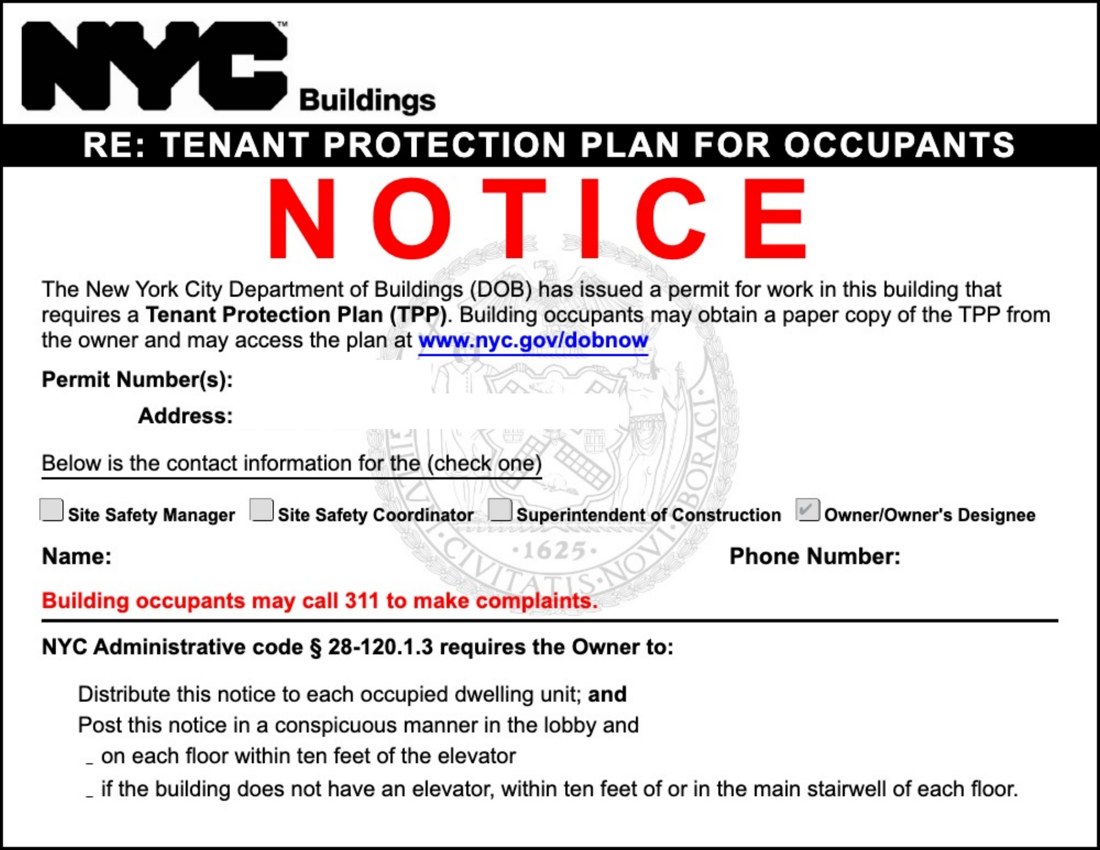
- Permit issued & plan made public. Once the permit is issued, DOB makes the TPP available online, and occupants can request a paper copy from the owner.
- Notices to residents. The owner distributes a TPP notice to each occupied unit and posts it in the building, along with the Safe Construction Bill of Rights.
- 72-hour notice to DOB. The owner notifies the Department before work under the TPP begins.
- Compliance inspections throughout the job. An independent Special Inspection Agency verifies the plan is being followed, from pre-construction through completion.
- Updates when work changes. If the work area or methods change, the plan and protections are updated, and phased layouts can be submitted as the job progresses.
TPP Compliance Special Inspections
For work that requires a TPP, NYC Building Code BC 1705.26 calls for third-party Tenant Protection Plan compliance inspections. The goal is to confirm that what was promised on paper is actually in place in the field.
| Inspection | Purpose |
|---|---|
| Before work begins | Document existing conditions in the building |
| At start of work | Verify barriers, egress and protection measures are installed as planned |
| Weekly during work | Confirm protections are maintained as conditions change |
| After a TPP violation | Verify the condition has been corrected |
| When the work moves | Check protections at the new work location |
| When methods change | Confirm protections match the new means and methods |
Independence matters. The owner, not the contractor, hires the special inspector. Under DOB guidance, the TPP applicant of record cannot also act as the Special Inspection Agency for the TPP compliance inspection on the same job. If we prepare your plan, we will tell you up front, and we can perform the inspections on jobs where we are not the TPP applicant.
Hazards are escalated. Conditions that endanger residents are reported to DOB immediately. Residents can also report suspected TPP violations to 311 and ask for the Multiple Dwellings Inspection Unit.
Limited exemptions exist, for example for certain interior work in owner-occupied units that does not disrupt services. Confirm the requirements for your specific filing.
Penalties and Enforcement
Tenant protection is one of the most actively enforced areas of the NYC Construction Codes. Where a TPP is required but has not been submitted, the minimum civil penalty is $10,000, rising to at least $25,000 for each subsequent offense. Inadequate plans, failure to follow the plan, missing postings and missing DOB notifications carry additional OATH penalties, and dangerous conditions can lead to a Stop Work Order, often the most expensive outcome for a project schedule.
Common TPP Mistakes We See in the Field
How Momentum Helps
TPP Preparation
Site-specific plans and drawings prepared and sealed by a Professional Engineer, addressing all seven categories, including phased layouts for multi-stage work.
TPP Compliance Inspections
Pre-construction, start-up, weekly and event-based inspections with photo-documented reports, on jobs where we are independent of the TPP applicant.
Owner & Contractor Support
Guidance on notices, postings and DOB notifications, plus fast, practical corrections when field conditions don’t match the plan.
This guide is general information about NYC requirements as of November 2026 and is not legal advice. Requirements are confirmed for each project against the current NYC Construction Codes and DOB rules.